The Weekly Workflow That Fits Around a 9-to-5: Four Blocks, One Page, No Guilt
A workflow for a side business around a 9-to-5 has one job: it has to survive your worst week at the day job, not just your best one. Plenty of schedules look great on Sunday night and fall apart by the third Thursday. This article gives you a single page you can copy into a calendar tonight, built from four repeatable blocks: create, publish, learn, and review.
The hours counted below are examples. Swap in your own, because the plan works only if it matches the time your job actually leaves you.
Why most side-business schedules collapse by week three
The usual plan is written for an imaginary person with free evenings: write two hours every night, post daily, study on the weekend. The first week runs on novelty. In the second week, a deadline at work pushes one evening out. By the third week, you have missed three sessions, the plan has no way to absorb that, and the whole thing feels like a failure.
Three design flaws cause most of this:
- The schedule assumes every evening is available, so one lost evening breaks it.
- Every session is a different kind of task, so you spend the first fifteen minutes deciding what to do.
- Nothing says what to do after a missed week, so people either try to catch up or stop.
The fix is a smaller plan with fixed block types, a minimum version of each block, and a written rule for bad weeks. The rest of this article builds those three things.
Start from your real hours: map the week your job actually leaves you
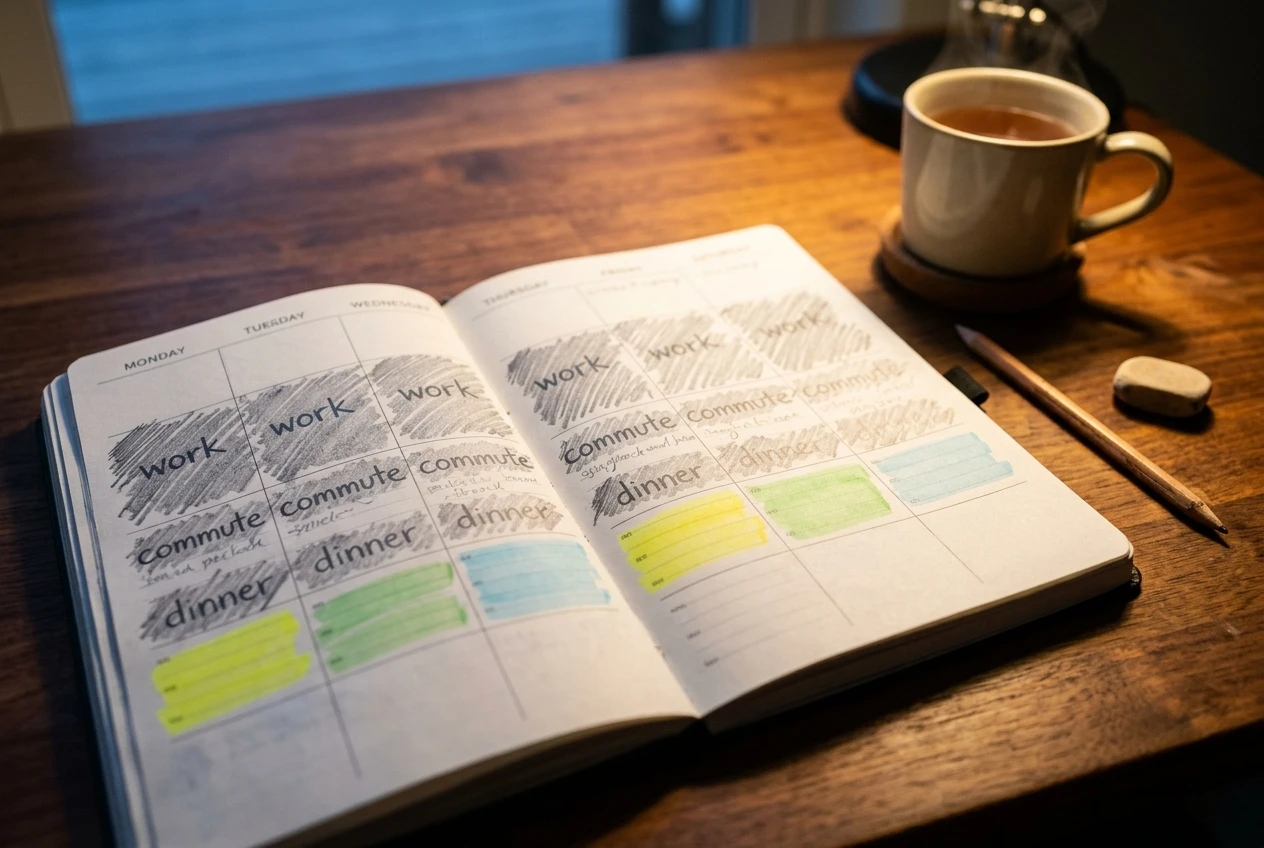
Before you add anything, subtract. Open a calendar and mark everything already taken: work hours, commute, meals, exercise, family time, sleep. What remains is your real capacity, and it is almost always smaller than the number you had in your head.
Then sort what remains by energy, not just by clock time. For most people with a full-time job, the evening right after work is low energy, and a weekend morning is high energy. Mark each open slot as one of three kinds:
- Fresh: you can think clearly and write something from nothing.
- Okay: you can work from a plan someone (you, earlier) already made.
- Flat: you can click, copy, paste and tidy.
Be strict about this. A 45-minute slot on a flat Tuesday is not a writing slot, and pretending otherwise is how sessions get skipped. If you find only three or four usable slots in a week, that is enough to start. Many people find the small number a relief once they see it on paper; the post on why having only an hour a night can be an advantage covers why limited time can sharpen your focus.
The four blocks: create, publish, learn, review

Every session you schedule gets one of four labels. When you sit down, you never ask what to work on; you read the label.
Create
This is the block where something new comes into existence: a draft article, a video script, an outline for a page. It is the heart of the business, so it gets the most time and your freshest slots. A reasonable share is about half of your weekly hours.
Publish
Publishing is a separate block because finishing and releasing are different tasks. Here you proofread, add images, set the title and link, schedule or post, and update any related pages. Keeping it apart from creating stops you from holding back a finished piece because it could still be improved. Plan about 15 percent of your hours here.
Learn
This block is for one skill at a time: how to research keywords, how to structure a script, how to read your site’s numbers. Choose a single topic for the week and stay with it. Around 15 to 20 percent of your hours is enough. More than that, and learning starts to replace making, which feels productive but produces nothing for readers.
Review
Review is a short block, about 15 percent, where you look at what you did and set up next week. You check what was published, what is still unfinished, and which create task goes first on Tuesday. Without this block, the plan has no memory, and each week starts from zero.
Build your one-page weekly plan (and what a realistic week looks like)
The page has seven lines, one per day, and each line holds a block label, a length, and a specific task. Here is an example for someone who found four evening slots and a weekend morning:
Day Block Length Task Monday Rest 0 Nothing scheduled Tuesday Create (flat-friendly) 45 min Outline next article, gather links Wednesday Create 45 min Write first half of the draft Thursday Learn 30 min One lesson on this week’s skill Friday Rest 0 Nothing scheduled Saturday Create, then Publish 90 min + 30 min Finish draft, edit, publish Sunday Review 30 min Check results, set next week’s tasks
That is four and a half hours in total. It will not impress anyone, and it does not need to. Four and a half hours kept for months produces more than fifteen hours planned for one week and abandoned.
Notice the two rest days. They are part of the plan, not gaps in it. A schedule with no days off teaches you to ignore the schedule.
Write the task on each line in advance, during the Sunday review. “Work on the site” is not a task. “Write the intro and first two headings of the article on evening commutes” is one. A specific task removes the decision, and decisions are what tired people avoid.
Batching tasks so a tired Tuesday still counts.
Create work comes in two kinds: work that needs thinking and work that only needs doing. Separate them, and you can use flat slots properly.
Thinking work includes choosing the angle, writing the first draft, and deciding what a reader needs. Put it in fresh slots. Doing work includes:
- Writing headline options from an outline that already exists
- Collecting the links and sources you will reference
- Formatting a draft and checking spelling
- Finding and adding images
- Scheduling a finished piece
- Listing next week’s article ideas from a notes file
Spend a fresh slot producing an outline and the raw material, then do the batch of mechanical tasks on a flat evening. Doing the same type of task back to back is faster than switching, because you stay in one mode.
Set a minimum version for each block too. For create, it might be 15 minutes and one paragraph. For learn, one lesson with one note. A minimum session counts as a session. If you are exhausted and you open the file and write one paragraph, the habit survives, and you have a start for tomorrow. The tired-brain mistakes that stall a side business are worth a read if you want to know which errors show up most when you work after a full day.
The bad-week rule: how to reset without quitting
Some weeks the job takes everything: a launch, a deadline, a sick colleague, a family emergency. The plan needs a rule for those weeks written before they happen, because you will not make good decisions while stressed.

Here is a rule you can copy:
- Drop to the floor. In a bad week, the only requirements are one 15-minute create session and the Sunday review. Everything else is optional.
- Do not make up the hours. Missed time is gone. Adding it to next week makes next week a bad week too.
- Reset on Sunday in ten minutes. Open the page, pick one create task for Tuesday, and write it on the Tuesday line. Then stop.
- Resume the normal plan. The following week uses the standard page, with no apology and no extra load.
If you have two bad weeks in a row, remove one block from the plan for a while instead of quitting. Cutting learn for a month still leaves you creating, publishing, and reviewing. A smaller routine you can keep is better than a full routine you keep failing.
The point of the rule is to remove guilt from the equation. A missed week is a scheduled possibility with a defined response, not a verdict on whether you can build this.
Where your site and YouTube fit into the same workflow
If you plan to publish both a website and a YouTube channel, do not build two separate routines. Use one idea for both. The article you create on Saturday becomes the outline for a short video, and the video points back to the article.
In practice, each piece of content moves through the same four blocks:
- Create: write the article first. When it is done, turn its headings into the sections of a video script.
- Publish: post the article, then upload or schedule the video and put the article’s address in the description.
- Learn: pick a skill that serves both, such as structuring a script so it sends viewers to your page. The post on how to write a YouTube script that sends viewers to your website is a good place for that lesson.
- Review: check which article and which video each got attention, and note what to repeat.
Start with the site alone if the full week feels tight. Add video once the article rhythm is steady, using the same create block rather than a new one. One idea turned into two formats costs far less than two ideas.
Run it for two weeks, then adjust one thing.
Do not rebuild the plan after the first uncomfortable session. Run the page exactly as written for two full weeks, including at least one imperfect day, and keep a short note after each session: what you did, how it felt, what got in the way.
At the end of the second Sunday review, change one thing. Possibly the Wednesday slot is always too tired for writing, so you swap it with the Thursday learn block. Maybe the Saturday session runs long and publish keeps getting squeezed, so you move publish to Sunday. Changing a single variable lets you see what the change did. Changing five tells you nothing.
If you are still deciding whether the whole idea suits you, this two-week test for starting a side business around your 9-to-5 can help you decide before you commit to the plan.
Map your week tonight.
Open your calendar, mark what your job and life already take, and label the remaining slots fresh, okay, or flat. Assign create, publish, learn, and review to those slots, write a specific task on each line, and add the bad-week rule at the bottom of the page. That is the whole workflow.
If you want a place to build the site and keep your workflow in one spot, you can start with Wealthy Affiliate through the referral link on this page.